By
AgilePoint
March 17, 2026
•
8
min read


If you work in manufacturing, you already know the grind isn't just on the line, but in approval queues, spreadsheet “workarounds,” vendor emails nobody has time to answer, and the constant cleanup when systems don’t match. Production might be tight, but the work around production is where teams quietly lose hours.
Robotic process automation (RPA) in manufacturing exists to take repetitive, rules-based work off teams who already have real operational problems to solve. Instead of burning skilled time on copying, checking, and re-entering data, RPA software bots handle those tasks quietly in the background.
So, what is robotic process automation? RPA uses software robots to execute structured, repeatable tasks such as data entry, validation, and status updates across systems. Rather than clicking through screens, RPA solutions follow defined rules to move information between applications, trigger actions, and flag exceptions when something doesn’t line up.
Leslie Willcocks’ research found that "a return on investment that varies between 30 and as much as 200 percent in the first year. In one organization we looked at, the return on investment for RPA was about 200 percent in the first year and they could implement it within three months."
Manufacturing operations have become more complex over time, even in plants that have “standardized” systems. Global supply chain management moves faster than most internal processes. Lead times change. Customer demands shift. Parts availability swings. A single delay can cascade into missed schedules and churn across teams.
At the same time, labor pressure is real. Deloitte’s analysis points to a net need of about 3.8 million new manufacturing employees in the U.S. between 2024 and 2033, with about 1.9 million roles potentially unfilled if skills and applicant gaps persist. That makes “just hire more coordinators” a shaky plan.
Most organizations also run enterprise resource planning (ERP) systems such as SAP, Oracle, legacy systems, and industry-specific tools. Those systems are powerful, but the handoffs between them are where things bog down. Approvals sit. Data gets re-keyed. Small mismatches turn into expensive delays.
That’s why RPA is showing up more and more in manufacturing and warehousing: it closes those gaps now, without waiting for a multi-year systems overhaul.
How does robotic process automation work in manufacturing? RPA improves efficiency, accuracy, and cost savings by freeing human workers for complex jobs. Capgemini’s 2025 manufacturing research reported that "Over half (54%) of organizations have already realized more than 20% cost savings through the adoption of these technologies" in their reindustrialization efforts. That’s not “RPA only,” but it lines up with what most manufacturing leaders already know. When you take friction out of the day-to-day, the savings stop being theoretical.
"Automating labor-intensive clerical work with RPA can reduce operational costs by up to 40-70%." — The Future of AI by Deloitte
When RPA is aimed at the right targets, the metrics usually show up in a few familiar places:
RPA is a good fit for the work in systems that keeps getting done the same way, all day, every day, and still somehow depends on someone to click through it by hand.
P2P is a goldmine for automation technologies because the steps are rule-based and high-volume. RPA can support vendor onboarding by checking required fields, validating tax details, and creating vendor records in ERP. It can also automate invoice processing by extracting data, matching it against purchase orders and receipts, flagging exceptions, and routing clean invoices for approval.
O2C breaks down when orders arrive in different formats and teams re-enter the same information across systems. RPA can automate sales order entry, validate pricing against customer terms, and generate invoices once shipments are confirmed. It can also trigger notifications when something is out of place, such as missing freight terms or a customer PO mismatch. The big gain is fewer downstream corrections, which means less churn between customer service, finance, and shipping.
Applications of RPA in manufacturing include optimizing supply chains, managing inventory or checking raw material numbers, ensuring compliance, and streamlining finance. RPA can pull current counts from warehouse systems, update ERP stock records, and reconcile variances on a schedule so teams aren’t chasing yesterday’s numbers. It also accelerates product delivery, leading to faster time-to-market.
Planning teams often lose time assembling a reliable picture of what’s happening across systems. RPA can pull inputs like demand forecasts, inventory levels, and workforce availability into a consistent view, surface exceptions early, and update schedules when conditions change. Instead of reacting after the plan slips, teams can adjust before small issues turn into missed commitments.
Quality and compliance work tends to come in waves, and a lot of it's repeatable. RPA can assist in quality control by collecting inspection results, ensuring required fields are completed, and routing nonconformance records to the right team. It can also automate compliance reporting and documentation when integrated with artificial intelligence (AI) technologies. With intelligent document processing, it can pull the right historical data, compiling what auditors ask for, and keeping audit trails consistent across systems.
Finance teams in manufacturing face high transaction volumes and tight deadlines. RPA can help by comparing datasets across ERP modules, flagging mismatches, and building clean exception queues for review. It can also handle parts of data migration during acquisitions or system upgrades, so teams aren’t stuck re-keying and double-checking records for weeks afterward.
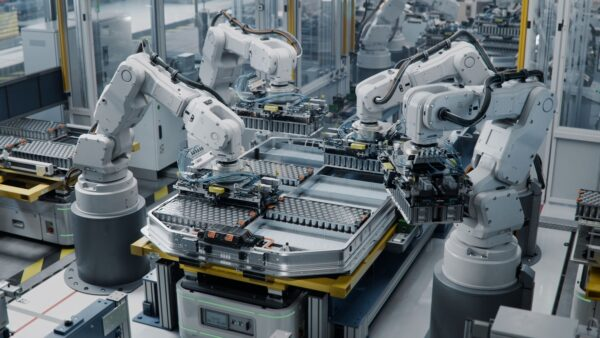
Seeing RPA in action makes it easier to picture how it fits into your own environment.
A discrete manufacturer has orders coming from multiple channels, each with slightly different rules. Bots handle ERP data entry and validation, confirm pricing logic, and trigger standard workflows for approvals when changes occur. Instead of planners and coordinators cleaning up order issues after the fact, exceptions are surfaced early.
In process manufacturing, batch records and compliance documentation never really let up. RPA can take the busywork out of that flow by pulling the required details from the right systems, checking for missing fields, and assembling a review-ready packet instead of making someone chase pieces across screens. When a batch deviation occurs, bots can notify the right owners, attach the right documentation, and log the event consistently.
Shared services teams are often buried in repetitive work across regions. Bots handle procurement routing, invoice triage, and standard HR or finance requests. That reduces queue times and creates consistency across business units without forcing every team into identical processes. A3’s manufacturing RPA overview describes RPA expanding across the supply chain, quality, preventive maintenance, and administrative automation as manufacturers look for practical relief.
Bots fail quietly when processes change frequently. Screens move. Fields change names. Approval rules shift. If you don’t treat automation as something you own and maintain, you end up with bots that break, get ignored, and slowly turn into another source of backlog.
Manufacturing also has long-running work that doesn’t fit into a single bot “task.” A purchase order can stretch across days because it involves checks, approvals, exceptions, and supplier back-and-forth. RPA can automate the repeatable parts of that flow with minimal human intervention, but something still has to manage the handoffs and keep the work from stalling when reality shows up.
That’s where things are heading next. In 2026, robotic process automation trends in manufacturing have evolved into a foundational layer for agentic automation and hyperautomation, meaning it’s often the underlying execution layer that other automation builds on. RPA is doing more of the repeatable execution, while orchestration handles visibility and ownership across the workflow.
The integration of RPA with AI allows bots to handle unstructured data and learn from patterns to improve over time. AI is starting to help with messy inputs like emails and PDFs, so exceptions don’t automatically turn into a manual fire drill.
Manufacturers usually end up with a mix of automation tools because their environments are a mix of systems.
Task-based tools are best at knocking out individual steps, things like manual data entry, validations, transfers, and standardized notifications. They do best when the steps don’t change much and the screens aren’t getting rearranged every time there’s an update. That’s why teams often start here. You can pick one messy, repetitive back-office operation, automate it, and feel the difference fast, like invoice routing or routine order updates.
Most ERPs already have workflow and automation features baked in, and that can be enough when the work stays inside the ERP. The limitation arises when the workflow spans systems such as supplier portals, MES, WMS, and customer-facing tools. ERP-native automation is often strongest inside the ERP boundary, not across the full operational landscape.
Traditional RPA tends to struggle with cross-system orchestration, governance, and long-running processes. It can perform repetitive tasks easily, but it doesn't naturally manage handoffs, track accountability, or maintain resilience when upstream and downstream systems evolve.
Many manufacturers don't need “another tool.” They need fewer disconnected islands.
Most manufacturing work isn’t one clean task but a chain of steps that moves between systems and people. RPA can take pieces of that workload, but it won’t manage the whole chain by itself. Orchestration is what keeps work from stalling — it routes the next step to the right owner, keeps context attached, tracks status end-to-end, and escalates when something sits too long.
Manufacturing workflows change constantly. When every adjustment requires a full development cycle, automation becomes slow and fragile.
That’s where low-code automation helps. It gives operations and IT a faster way to update forms, routing, approvals, and integrations without rebuilding the workflow from scratch every time something changes. AgilePoint is built for that kind of change, especially in environments where systems don’t talk to each other cleanly.
In most plants, ERP, MES, WMS, supplier portals, and reporting tools all have roles to play. The practical goal isn’t to replace them, but to connect them so data and handoffs move without someone retyping the same information in three places.
Integration means RPA can pull updates from one system, validate them, then write the right fields into another system, and trigger the next step automatically. That could be updating inventory in ERP after a warehouse scan, kicking off a purchase request when stock hits a threshold, or routing a change order for approval with the right context attached.
In manufacturing, RPA handles repetitive tasks, but orchestration keeps workflows moving when approvals, exceptions, and legacy systems are all involved. Here’s how the approaches compare.
The combined model is usually the best fit in manufacturing because it keeps task automation practical while making workflows resilient and governable.
Industrial robots do physical work on the floor. RPA does digital work in software systems. They solve different problems, but they often support the same goal: fewer delays and fewer avoidable errors.
Physical robotics handle production tasks. Digital automation handles planning, procurement, finance, quality documentation, and system updates. Most manufacturers use both, because both are necessary.
It can be, if it's implemented with proper access controls, audit trails, and governance. Continuous monitoring and maintenance of RPA bots are necessary to ensure their effectiveness in manufacturing.
Natural language processing helps systems process human language seen in everyday text, from emails and notes to chats or free-form comments. Machine learning spots patterns in data over time, which is useful for things like flagging anomalies or feeding predictive maintenance.
Manufacturing runs on repetitive tasks, handoffs, approvals, exceptions, and timelines that stretch across days or weeks. That is why scalable, intelligent automation has to be governed and connected end-to-end, not stacked as isolated bot scripts.
If your teams are buried in manual coordination and you’re looking for manufacturing automation solutions that will hold up as systems and demand change, contact AgilePoint today. We’ll help you pinpoint the right workflows to automate first, prove value fast, and build a foundation you can scale without creating a new pile of bot maintenance.



.png)
.png)


.jpg)



%20(2).webp)


-1280w.avif)