.avif)
A seismic shift is unfolding in enterprise automation. Traditional tools, designed for 'happy-path' processes, are becoming insufficient in handling complex, dynamic workflows. Think of Agentic AI as software that can notice a situation, choose a next step, and carry it out without waiting for a human to click through every screen.
In a large organization, those agents can push routine work forward, clear simple exceptions, and keep processes on track so teams can focus on the projects that actually grow the business.
What Is an Agentic AI Maturity Model?
An agentic AI maturity model gives your company a plain way to describe how far automation has actually progressed, instead of guessing based on a few success stories.
At the first stage, most teams still lean on basic rules, scripts, and straightforward routing between steps. The software follows a path that someone designed long ago and breaks when a new product, policy, or exception shows up.
People are the ones filling in the gaps, using their own judgment to deal with exceptions, side cases, and messy data that the system cannot interpret on its own.
AI agents look at history, policies, and live data to suggest or take the next step. Later on, those agents can pass work between one another, line up activity across departments, and adjust their behavior based on what just happened rather than repeating a fixed script.
The maturity model then works as a simple scorecard that shows where data is solid, where guardrails still need to be built, and which decisions should remain under human control instead of being handed to a “fully automated” flow.
Scaling Agentic AI Systems
Running one impressive pilot is the easy part; the real test is letting agents handle work every day in production while different teams rely on the results.
In many large companies, finance works in one older system, operations relies on a newer cloud tool, and each department has a few homegrown fixes holding their process together. If each agent plugs into that maze in its own way, you end up with behavior that is hard to explain and even harder to trust when something goes wrong.
Clear roles help. One agent can gather information, another can suggest actions, and a third can track what was done so people can review it later.
This becomes especially important for healthcare automation solutions and financial services automation, where mistakes have real impact on patients and customers. Here, agents can handle the heavy lifting of pulling records together, spotting odd patterns, and drafting recommendations while clinicians, analysts, or risk teams make the final call. The result is faster handling of everyday work, fewer dropped handoffs between systems, and more time for staff to focus on cases that genuinely need human attention.
Why Enterprises Need Agentic AI
For decades, automation has prioritized bottom-line efficiency, facilitating repetitive tasks through rule-based workflows. However, these traditional systems crumble under the pressure of real-time exceptions, requiring costly manual interventions.
A Gartner survey underscores this paradigm shift: in both 2024 and 2025, CEOs ranked "Growth" as their top priority, while "Efficiency and Productivity" were placed last. Businesses are now tasked with balancing efficiency with adaptability and innovation, which requires a departure from static automation to Agentic AI-driven systems.
The Agentic AI Maturity Model: From Automation to Closed-Loop Optimization
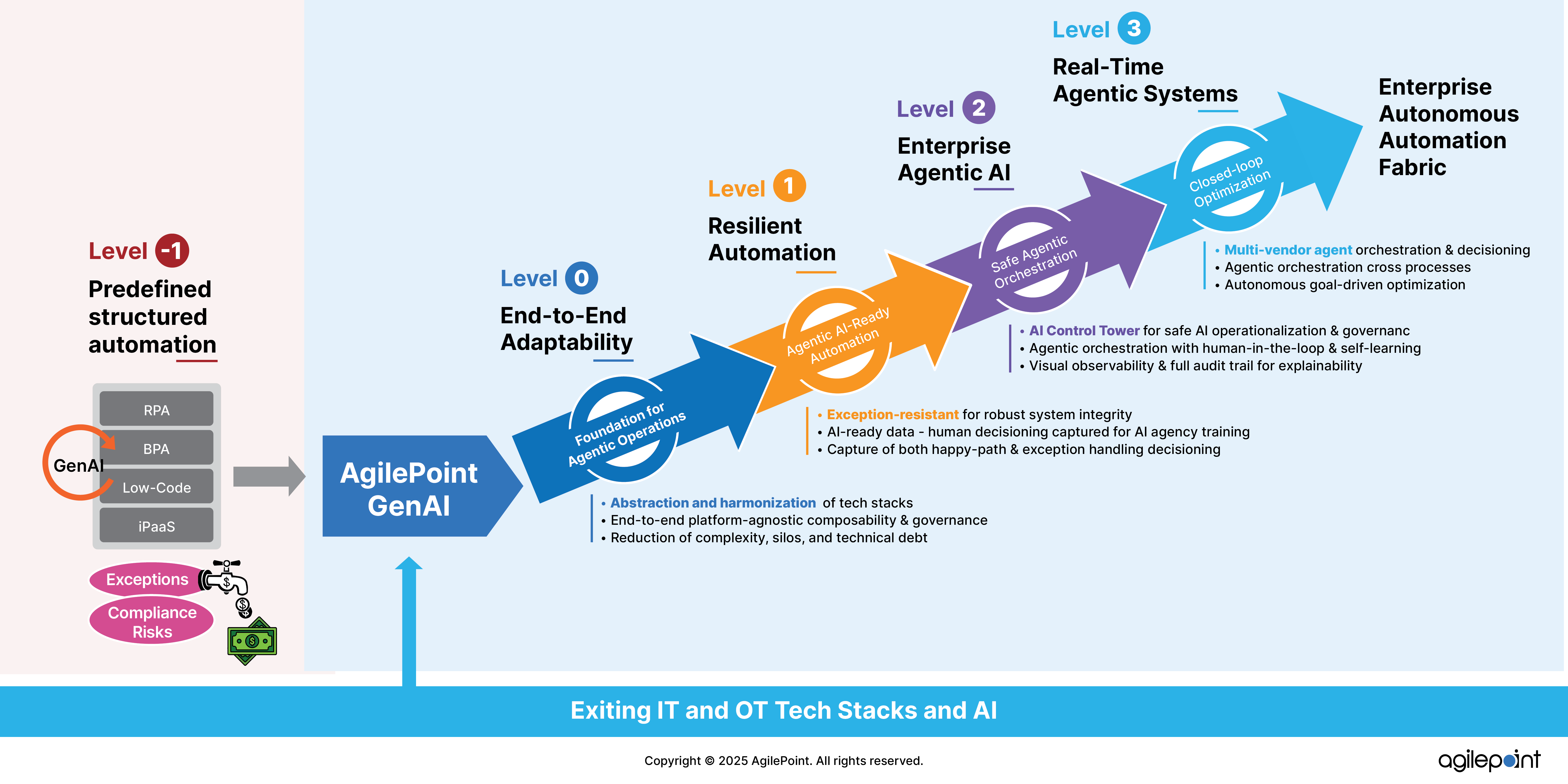
AgilePoint’s Agentic AI Maturity Model offers a structured pathway for organizations to evolve their automation capabilities. But before diving into the maturity levels, it’s essential to recognize where most organizations begin: happy-path automation which is stated as level -1 in the maturity model.
Level -1: Happy-Path Automation
Before organizations can begin their journey toward Agentic AI maturity, they typically start with legacy systems characterized by:
- Low-ROI task-centric AI use cases.
- 'Happy-path' applications and automation.
- High reliance on manual exception handling.
- Siloed systems & limited integration.
- Hardcoded business logic.
These systems focus on workflows designed for ideal conditions, assuming no deviations or exceptions. While they deliver initial efficiency gains, they lack the adaptability needed for complex, real-world scenarios.
As businesses encounter dynamic market demands and increasing complexity, happy-path automation reveals its limitations. This is where the journey toward maturity begins—with the transition to a platform-agnostic, composable architecture at Level 1.
Level 0: Platform-Agnostic Composability
The first level establishes a foundational, platform-agnostic, composable architecture. This composability enables seamless integration across systems, harmonizing data and application assets to create a resilient digital ecosystem.
Key Features:
- Agentic-ready modularity with existing Tech Stack.
- Abstracted and harmonized composability.
- Reduction of technical debt, complexity, and silo.
- Adaptive security governance frameworks.
The emphasis here is on creating a robust infrastructure that can support higher levels of process maturity, addressing the limitations of static, rule-based automation.
Level 1: Resilient Automation
Organizations at this level begin to address the limitations of happy-path automation. Systems are enhanced to handle exceptions in real time, capturing both structured workflows and unstructured exception data.
Key Features:
- Exception-resistant automation and business orchestrations.
- Decision intelligence captured, including exceptions.
- Robust system integrity and governance.
- Decision intelligence captured, including exceptions.
AgilePoint's platform-agnostic architecture plays a pivotal role at this stage by harmonizing data and applications across siloed systems. This enables organizations to reduce complexity and establish a foundation for future-proof automation.
Level 2: Safe Agentic Orchestration
At this stage, Agentic AI begins to exhibit subject matter expertise. By training AI systems with both happy-path and exception-related data, organizations create systems capable of making contextually intelligent decisions.
What This Means:
- AI Control Tower for operationalization and governance.
- Human agency-level intelligence and human-in-the-loop.
- AI agents trained with proprietary decision intelligence.
- Multi-vendor and multi-agent agentic orchestration.
AgilePoint's comprehensive orchestration capabilities ensure that AI agents operate within a governed framework, balancing autonomous decision-making with human oversight to deliver safe, reliable, and intelligent process automation at scale.
Level 3: Closed-loop Optimization (Self-Learning & Self-Improving)
The pinnacle of the Agentic AI Maturity Model is closed-loop optimization, where systems continuously improve themselves based on real-time feedback and monitoring.
Key Outcomes:
- Real-time Agentic AI capabilities..
- Self-learning and self-improving.
- Agentic end-to-end automation fabric.
- Business-led innovation.
This level represents the ultimate fusion of agentic AI and enterprise automation, where business processes are no longer static but evolve dynamically to meet changing demands.
Benefits of Reaching Agentic AI Maturity
Once a company hits higher levels of maturity, automation stops being a helper and becomes part of how work gets done. Multiple agents working together can cover whole processes end-to-end.
In insurance, for instance, insurance automation software can have several agents reviewing claims, checking for fraud, and flagging exceptions. People step in only when the data looks off. That shift frees teams from chasing tickets and lets them focus on bigger issues.
The payoff shows up fast: faster decisions, cleaner audits, and systems that get smarter with every cycle. Feedback mechanisms built into the process help agents learn from what worked and what didn’t. Over time, that learning closes the loop — each pass through the system makes it sharper.
The Future: Agentic Systems as Business Infrastructure
Agentic AI isn’t just another upgrade — it’s becoming part of enterprise infrastructure. The next phase will mix generative AI for creation, task automation for execution, and agentic intelligence for reasoning and control. These pieces work together, combining AI capabilities to keep enterprise operations flexible and resilient.
Future systems will use layered AI governance and clear feedback channels to stay reliable. They’ll coordinate across multiple domains, adjusting rules as they go and handing off tasks to other agents when the work calls for it. What starts as assistance turns into real partnership.
When autonomous AI agents can adapt safely within defined limits, organizations move past efficiency and into innovation — systems that don’t just follow instructions but improve the business itself.
AgilePoint: Accelerating Your Journey to Agentic AI
AgilePoint's abstracted, platform-agnostic architecture provides the tools and infrastructure required to progress through the Agentic AI Maturity Model. By harmonizing data, application logic, and business processes across heterogeneous IT stacks, AgilePoint empowers organizations to:
- Move beyond rule-based automation.
- Implement adaptive, resilient workflows.
- Achieve closed-loop optimization.
The AgilePoint Maturity Model aligns with Satya Nadella's prediction of a future where AI agents drive business logic autonomously. By adopting this model, organizations can accelerate their transition from years to months, unlocking unprecedented productivity and innovation gains.
Conclusion
The Agentic AI Maturity Model is not merely a framework but a strategic imperative for organizations seeking to thrive in a rapidly evolving business landscape.
By moving beyond static automation and embracing run-time resiliency, decision intelligence, and closed-loop optimization, enterprises can achieve both top-line growth and bottom-line efficiency.
AgilePoint is at the forefront of this transformation, providing the tools and expertise needed to operationalize Agentic AI at scale.
Frequently Asked Questions:
What is the maturity of agentic AI?
It’s a measure of how far an organization has come in adopting agentic AI systems. Early stages use static automation; advanced stages use coordinated, autonomous agents that adjust in real time.
What is an agentic AI model?
An agentic AI model is a system of connected, autonomous AI agents that collaborate to manage tasks and make decisions across departments. They follow predefined rules when needed but can adapt as conditions change.
What is the maturity model of AI?
It’s a framework that tracks progress from simple automation to full autonomy. It helps teams understand where they rely on human intervention and where AI can safely step in.
.png)
.png)